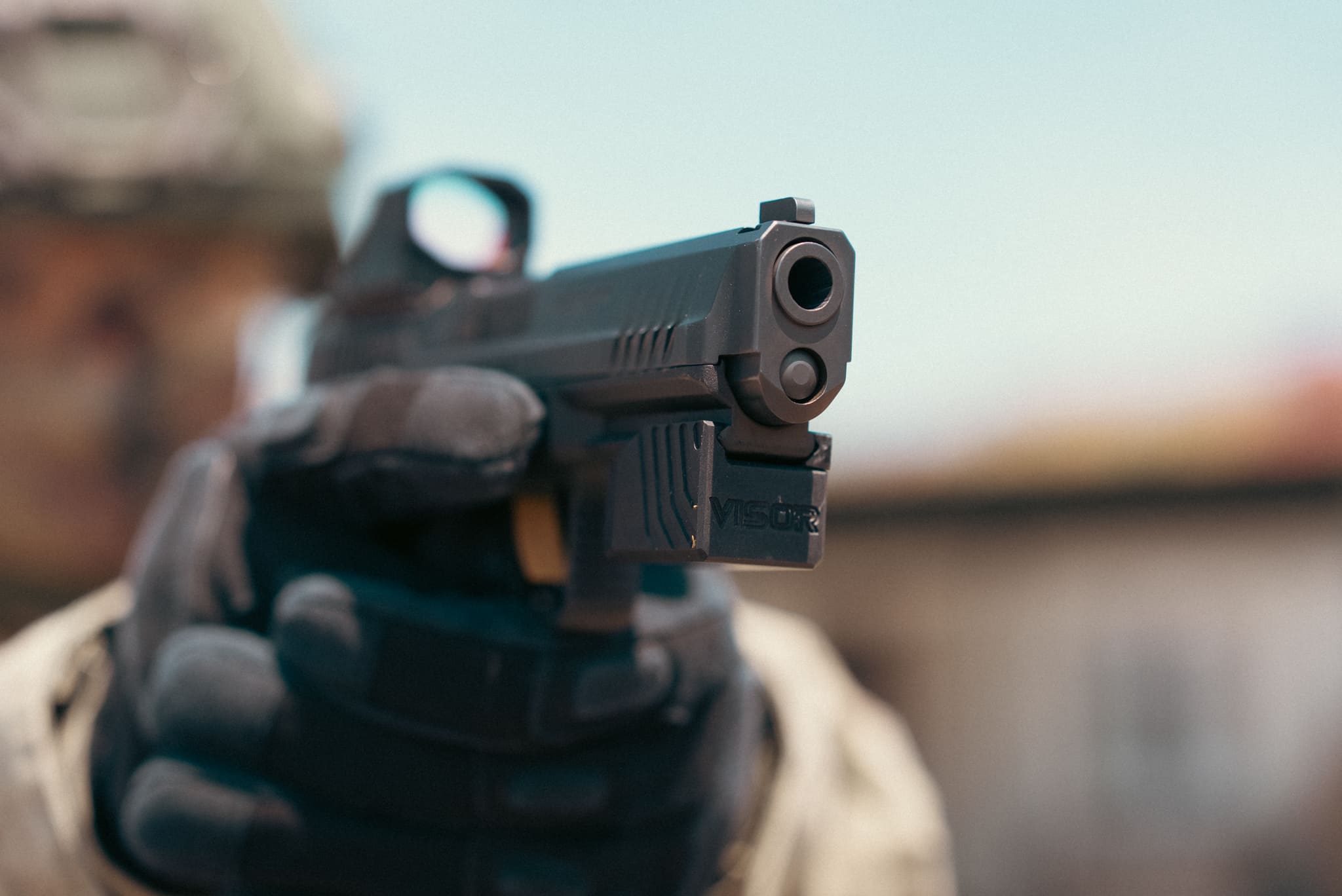
Trigger control is often described as the single most important skill in shooting.
Yet most shooters think about it the wrong way. They focus on when to pull the trigger, when the real skill lies in how the trigger is pressed — and what happens in the moments before it breaks.
Trigger control is not a single action. It is a chain of small, precise events happening in fractions of a second, and understanding that chain is what separates consistent shooters from inconsistent ones.

What Actually Happens When You Pull the Trigger
From the shooter's perspective, pressing the trigger feels instantaneous.
In reality, it is a sequence:
- Initial trigger take-up
- Building pressure against the wall
- The final press through the break point
- Trigger reset
- Follow-through after the shot
Every one of these stages can introduce movement. And on a handgun or rifle, even a fraction of a millimeter of unwanted movement at the muzzle translates into inches — or feet — of deviation at the target.
This is why trigger control is not just a hand skill. It is a stability skill.

The Real Enemy: Disturbance, Not Direction
Many shooters assume that trigger control is about pulling straight back.
In practice, the bigger issue is disturbance.
Every trigger press interacts with the rest of the grip. Small compensations happen automatically — the hand tightens, the wrist shifts, the muzzle dips. These movements are often too small to feel, but not too small to see on target.
Common disturbances include:
- Anticipation, where the shooter reacts to the expected recoil before it happens
- Grip tension changes during the press
- Trigger finger movement affecting the rest of the hand
- Milking, where the entire hand closes rather than just the trigger finger
None of these are intentional. That is exactly why they are so difficult to fix through feel alone.
Why the Brain Struggles to Detect These Errors
Trigger control errors typically happen in under a quarter of a second.
Human proprioception — the sense of where your body is and what it is doing — is simply not fast enough to catch movement at that timescale. A shooter can execute a flawed trigger press and feel like it was perfect.
This is why experienced instructors rarely ask shooters what they felt.
Instead, they look at what the muzzle actually did.
Building the Neural Pathway
Trigger control, like any motor skill, is learned through repetition.
Each time a shooter presses the trigger correctly, the movement pattern is reinforced. Each time it is pressed incorrectly, an inconsistent pattern is reinforced instead.
The problem is that without feedback, the brain cannot tell the difference.
A shooter can repeat an inconsistent trigger press hundreds of times, believing they are building good habits, while actually reinforcing errors that will surface under pressure — on the range, in competition, or in the field.
This is why quality of repetition matters more than quantity.
Why Trigger Control Cannot Be Trained by Feel Alone
Trigger control lives in a space too fast and too subtle for self-assessment.
Traditional training methods rely on the shooter noticing their own errors, or an instructor observing from the outside. Both approaches are limited — instructors cannot see inside the shooter's grip, and shooters cannot feel movement measured in milliseconds.
What is needed is objective, moment-by-moment data on what the muzzle is doing during the press itself.
Making Trigger Control Measurable
This is where modern shooting analysis changes the equation.
By tracking weapon movement continuously — before, during, and after the trigger press — it becomes possible to see exactly what happens at the moment that matters most.
Instead of guessing, shooters can identify:
- Whether the muzzle moves during the press
- Whether anticipation is occurring before the shot
- How stable the weapon remains through the break
- Whether follow-through is being disrupted
This turns trigger control from a feeling into a fact.
From Awareness to Correction
Identifying an error is only the first step. Correcting it requires repetition with feedback.
VISOR was built around this principle. By analyzing weapon movement through every stage of the trigger press — during dry fire, laser training, or live fire — VISOR gives shooters objective insight into exactly how their trigger control is performing, repetition after repetition.
Instead of wondering whether a press was clean, shooters can see it.
Instead of guessing at the cause of a missed shot, shooters can identify it.
Precision Is Built, Not Assumed
Trigger control cannot be mastered through instinct alone.
It is a skill built through structured repetition, refined through feedback, and perfected through measurable progress.
The science is clear: what you cannot see, you cannot fully correct.
VISOR makes the invisible visible — turning every trigger press into an opportunity to improve.
Learn more about VISOR at www.visorlabs.co
Android Play Store: https://play.google.com/store/apps/details?id=com.visorai.app Apple App Store: https://apps.apple.com/tr/app/visor/id6775163107?l=tr