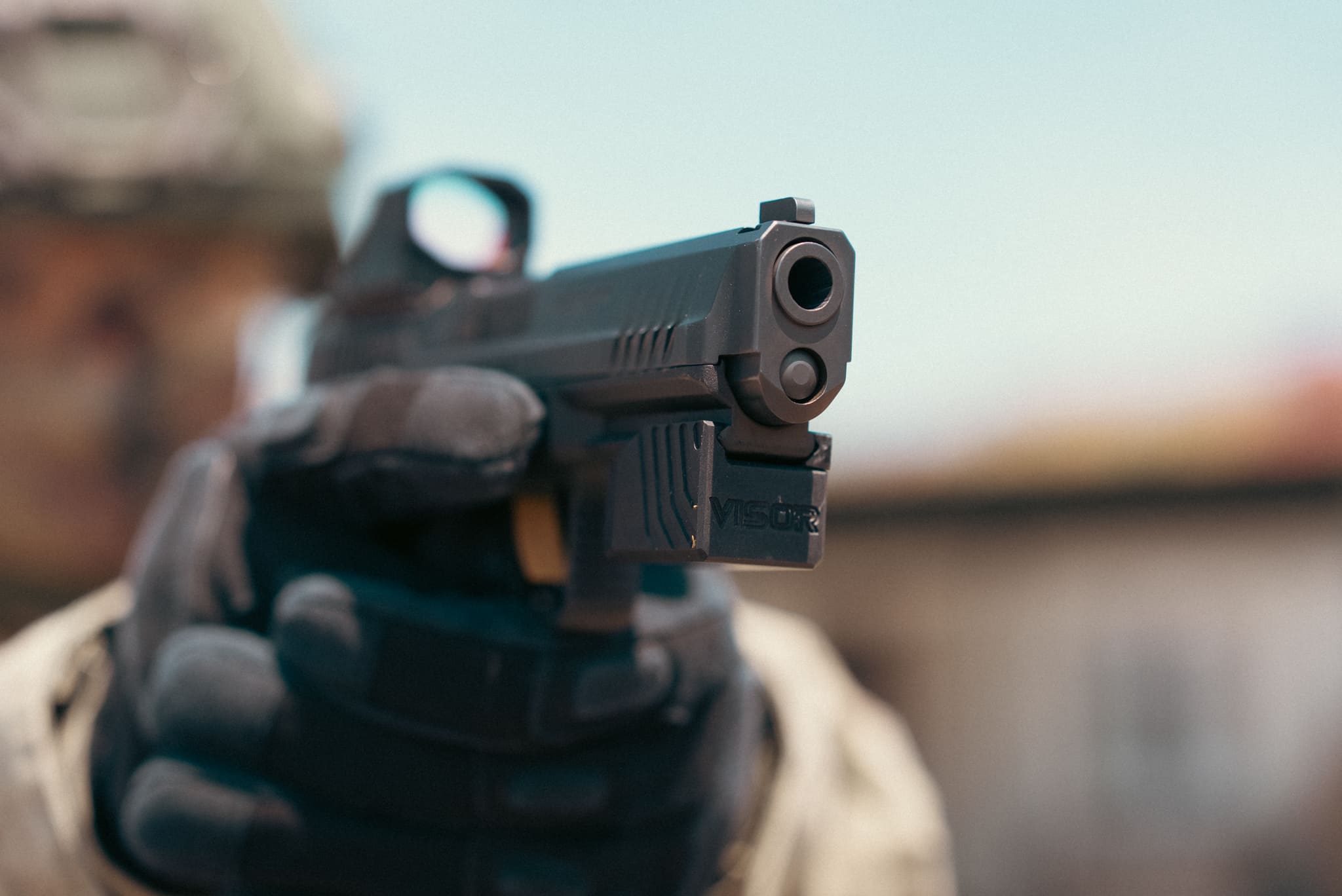
When we talk about shooting performance, trigger control, breathing rhythm, and sight alignment usually take center stage. But underneath all three lies a foundational variable that's often overlooked: grip pressure. How you hold the weapon is decided before every shot and continues to act on the system until the bullet leaves the barrel — yet in training it's usually reduced to a vague instruction like "grip it right."
In this article, we'll look at how grip pressure shapes shooting mechanics, why consistency matters more than absolute strength, and how to make this variable measurable.

Why Does Grip Matter So Much?
The weapon is the only physical interface between your hand and the barrel. The force you apply to the trigger, the recoil of the barrel, and every micro-vibration during the shot are all transmitted through your grip — to your body and back. This makes grip a two-way interface:
- Input direction: The tension in your hand muscles affects how the trigger finger moves.
- Output direction: The recoil energy generated during the shot is distributed along the barrel axis differently depending on how tightly you're gripping.
If the grip is too loose, the weapon "lives" in your hand during recoil — barrel deviation increases, and the return-to-sight time for follow-up shots lengthens. If the grip is too tight, the tension in the hand muscles spreads to the trigger finger as well, producing what's known in the literature as sympathetic contraction: it becomes harder to move the trigger finger in isolation, the entire hand tightens slightly at the moment of the shot, and this deflects the barrel.
Sympathetic Contraction: The Hidden Source of Error
When you clench your hand tightly, you might assume your index finger can still move completely independently — but neuromuscularly, this isn't quite accurate. Some hand muscles share common neural pathways (the flexor tendons are interconnected to a certain degree as they pass over the wrist). As grip force increases, the trigger finger's capacity to remain isolated decreases, and it tends to close involuntarily along with the other fingers.
This is one of the most common causes of barrel deviation at the final moment of the shot (typically down-and-left for a right-handed shooter), even among experienced shooters. Even if the trigger pull is technically correct, excessive grip pressure continues to produce this error "invisibly."
How Much Pressure Is the "Right" Pressure?
A common mistake here is treating grip as a problem of "strength." In reality, the decisive factor is consistency, not the absolute pressure value. The generally accepted approach in training literature and biomechanical studies is:
- Tight enough to control the weapon — enough to absorb recoil and let the barrel return quickly to the sight line after the shot.
- Loose enough to allow isolated movement of the trigger finger — enough to minimize the sympathetic contraction effect.
The range that satisfies both conditions varies from shooter to shooter; hand anatomy, muscle mass, the weapon's recoil characteristics, and even the day's fatigue level shift this range. That's why giving a universal number like "you should grip with X kilograms of force" is misleading. The real goal is to repeat the same pressure shot after shot.
Why Consistency Matters More Than the Absolute Value
What determines the shape of a shot group isn't perfection on a single shot, but the variance between shots. If your grip pressure fluctuates from shot to shot — tense on the first shot, loose on the fifth — your barrel deviation pattern shifts in a different direction each time, which enlarges the group and can even make it look like a random scatter.
But if grip pressure stays constant, the resulting deviation becomes systematic: it shifts in roughly the same direction and magnitude on every shot. Systematic error is correctable error — it can be compensated for with sight adjustment, grip angle, or hand position. Random error cannot be corrected, because it has no predictable pattern.
This is one of the most critical mindset shifts in shooting training: The goal isn't to find the "correct" pressure, but to find a "repeatable" one.

How Can You Make Grip Measurable?
In traditional training, grip pressure is largely a subjective matter of "feel" — the coach says "a bit tighter" or "loosen up," and the shooter interprets this according to their own perception. This slows down the feedback loop and hides inconsistency.
In a data-driven approach, the effects of grip pressure can be observed indirectly, even if not directly:
- Barrel vibration analysis: IMU data can track the amplitude of micro-oscillations on the barrel from the trigger pull through the moment of the shot. Grip inconsistency typically shows up as these oscillations having variable amplitude and direction from shot to shot.
- Post-shot recovery time: The time it takes for the barrel to return to its original sight line after recoil is directly related to grip tightness. Consistency in this duration is an indirect indicator that grip is also consistent.
- Acceleration pattern at the moment of the trigger break: The overall stability of the hand in the final phase of the trigger pull offers clues about the extent to which sympathetic contraction is coming into play.
Comparing this kind of data from shot to shot lets a shooter answer the question "why did my group open up today" with a measurable answer instead of a subjective guess.
Practical Training Recommendations
- Calibrate with dry fire. During dry fire, deliberately vary your grip pressure and observe how it affects your trigger finger's isolation. Notice at which pressure level your finger moves most independently.
- Set your grip before the shot, not during it. Trying to "adjust" your grip after raising the weapon is one of the biggest sources of inconsistency. Grip should be fixed before the trigger pull begins.
- Watch for the effect of fatigue. Toward the end of a long training session, fatigue in the hand muscles changes grip pressure without you noticing. The difference in group dispersion between the start and end of a session is often due to muscle fatigue rather than technique.
- Repeat the pattern, not the pressure. The goal isn't to find the "tightest" or "loosest" grip on every shot, but to find your own optimal point and turn it into a mechanical habit.
Conclusion
Grip pressure is one of the least discussed yet most fundamental components of shooting performance. No matter how perfect your trigger control is, inconsistency in grip can overshadow that effort. The good news is that this variable can be noticed, measured, and ultimately trained with the right observation and data support.
Progress in shooting is often less about learning something new and more about making something you already do consistent. Grip pressure is one of the clearest examples of this.
Learn more about VISOR at www.visorlabs.co
Android Play Store: https://play.google.com/store/apps/details?id=com.visorai.app Apple App Store: https://apps.apple.com/tr/app/visor/id6775163107?l=tr